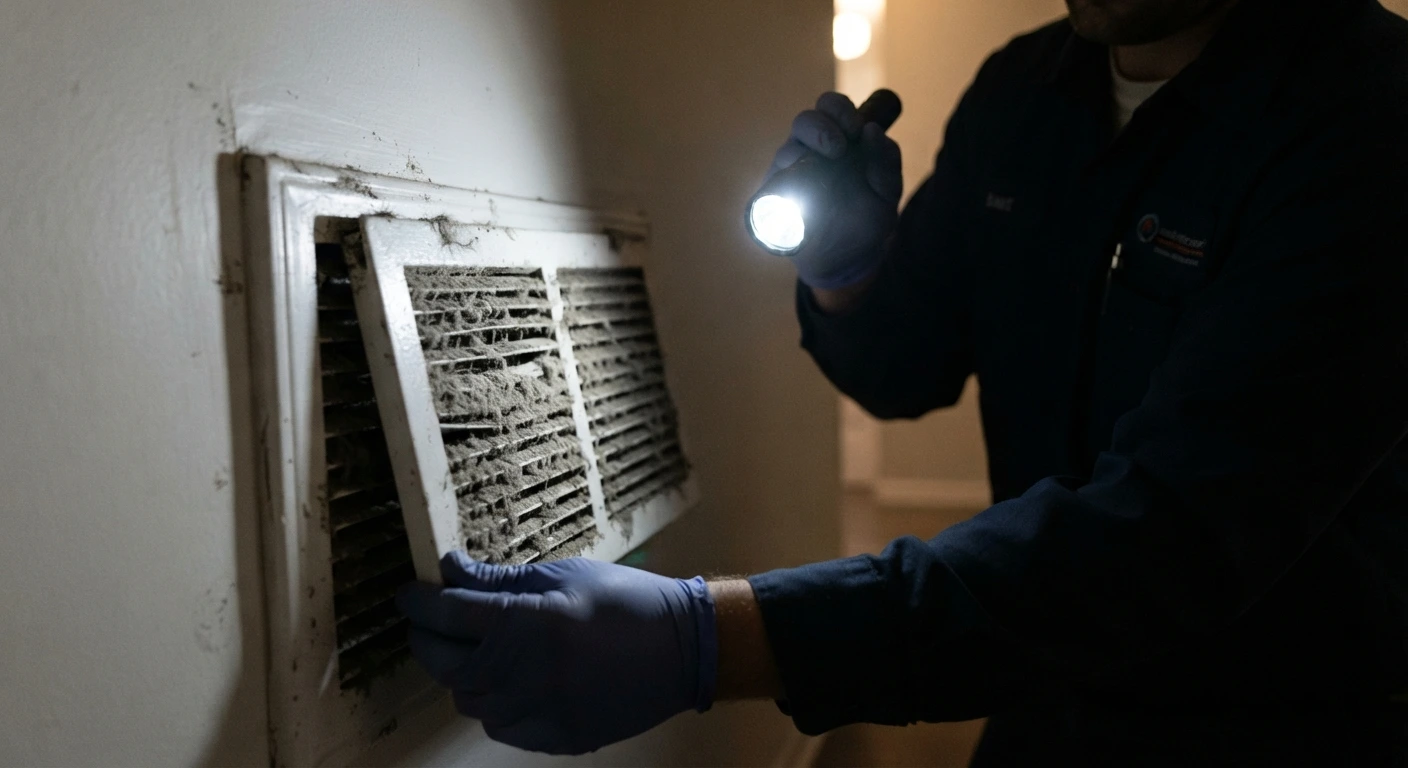
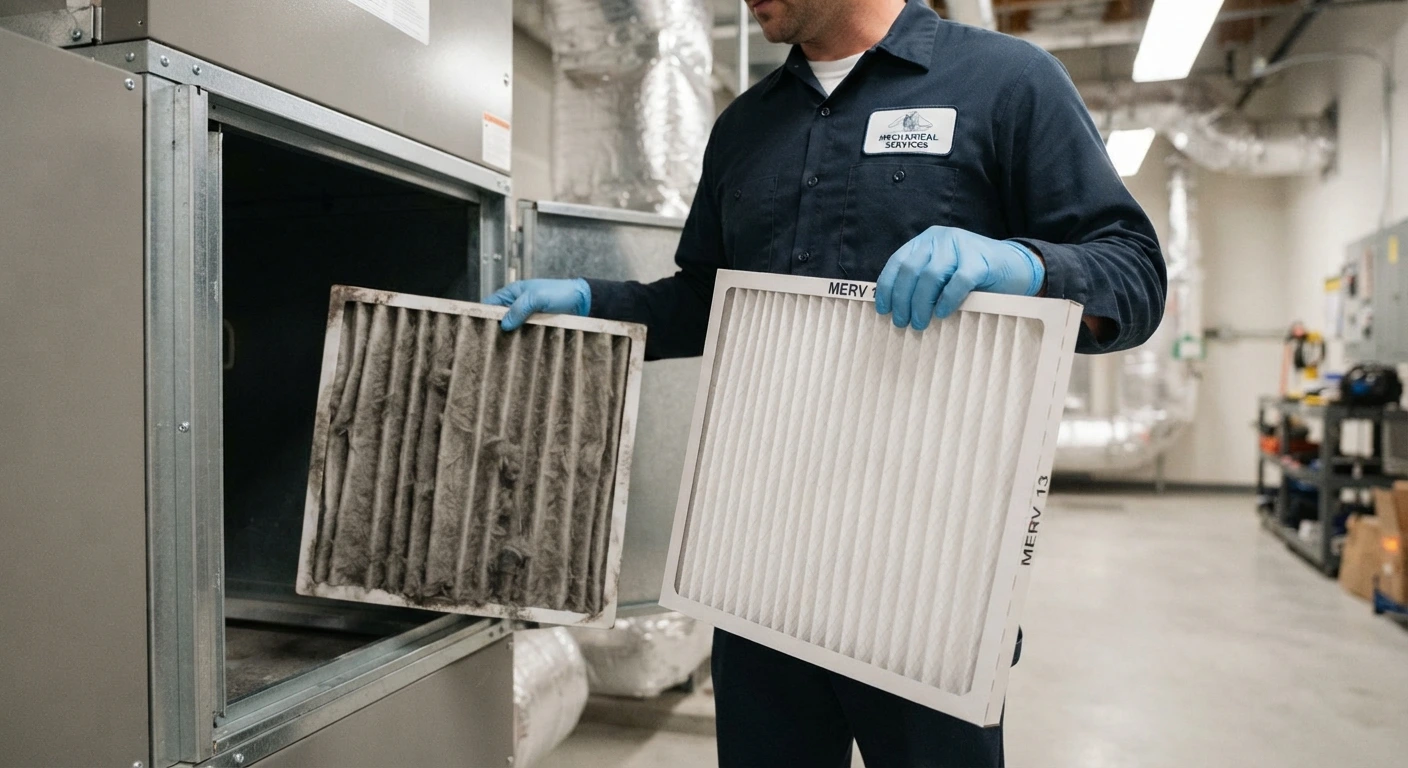
Installing a MERV 13 filter can improve particle filtration in a commercial or residential HVAC system. It can capture a greater share of small airborne particles before they continue through the system, but it cannot remove dust, debris, mold contamination, or pest material that has already settled inside ductwork.
That difference matters. A higher-efficiency HVAC air filter can help control what enters parts of the HVAC system in the future. Air duct cleaning addresses contamination already present when inspection shows that cleaning is needed. One does not automatically replace the other.
What Does a MERV 13 Filter Do?
MERV stands for Minimum Efficiency Reporting Value. The rating is used to compare how well HVAC filters capture particles between 0.3 and 10 microns as air passes through the filter.
The U.S. Environmental Protection Agency explains that higher MERV ratings indicate greater efficiency at trapping certain particle sizes. EPA guidance recommends choosing at least MERV 13, or the highest efficiency filter the HVAC system’s fan and filter slot can accommodate, when improved particle filtration is the goal.
A MERV 13 filter can capture particles in size ranges that include:
- Dust and fine airborne particles
- Pollen
- Some mold spores
- Pet dander
- Some bacteria
- Particles that can carry viruses
- Smoke particles within the filter’s tested particle range
The filter works while air moves through it. The EPA makes this point for ducted HVAC systems: filtration takes place when the system is operating.
For offices, stores, apartment buildings, schools, and other properties with central HVAC systems, this can make MERV 13 part of an indoor air management plan.
It is still only one part of that plan.
Does a MERV 13 Filter Keep Air Ducts Clean?
A MERV 13 filter can reduce the amount of airborne particulate matter that passes through the filter, which can help limit some future deposition downstream. It does not make the duct system immune to contamination.
Dust can enter or build up for several reasons that have little to do with the printed MERV number.
The filter can only capture air that travels through the filter media.
If air moves around the filter because of gaps, a loose filter rack, poor installation, or leakage, those particles do not receive MERV 13 filtration. ASHRAE notes that when air goes around a filter through leakage or bypass, it is not cleaned by that filter.
This is why filter fit matters almost as much as filter rating.
A MERV 13 product placed in a poorly sealed rack may provide less system-level filtration than its laboratory rating suggests.
HVAC filter bypass and duct contamination can also develop when return-side leaks allow unfiltered air to enter from ceilings, utility spaces, basements, attics, or other areas.
The filter has no chance to capture material that enters the duct system downstream of the filter.
What MERV 13 Does for Your HVAC Duct System
A correctly selected and installed HVAC air filter can support duct and HVAC maintenance in several ways.
MERV 13 Captures More Fine Particles from Moving Air
The main purpose of upgrading filtration is particle removal.
EPA defines MERV as a measure of a filter’s ability to capture particles from 0.3 to 10 microns. A higher rating means greater capture efficiency for specified particle sizes.
This can be useful in commercial buildings where HVAC systems move large amounts of recirculated air during occupied hours.
An office may deal with outdoor particles entering through doors and ventilation systems. A retail property has customer traffic throughout the day. A multifamily building may receive dust from corridors, maintenance work, and individual units.
A higher-efficiency filter gives the HVAC system a better chance to capture airborne particulate matter before that material continues through the system.
MERV 13 Can Reduce Some New Particle Loading
Every particle captured at the filter is a particle that does not continue through that filtration point.
Over time, this can help reduce new particulate loading on downstream HVAC surfaces compared with a lower-efficiency filter under similar conditions.
It is important not to overstate this benefit. A MERV 13 filter cannot stop all contamination. Particle capture is not 100 percent, bypass can occur, and contaminants can enter the system at other points.
Still, filtration forms an important part of contamination control.
The EPA’s duct guidance advises property owners to use effective filtration and check that filters are present and installed, so air cannot bypass them through gaps around the filter holder.
MERV 13 Can Support Indoor Particle Control
A central HVAC air filter also filters some of the air recirculating through occupied spaces.
This is why MERV 13 became an important filtration benchmark for offices and other occupied buildings.
Filtration does not remove every indoor pollutant, but it can lower concentrations of some airborne particles when the HVAC system runs, and enough room air passes through the filter.
For commercial properties, filter choice should be considered with ventilation, HVAC operation, source control, occupancy, and equipment maintenance rather than treated as a stand-alone solution.
What a MERV 13 Filter Does Not Do for Your Air Ducts
The limitations of MERV 13 are as important as its benefits.
A common mistake is assuming that installing a better filter solves every problem inside an existing HVAC system.
It does not.
A MERV 13 Filter Does Not Remove Dust Already Inside the Ducts
A filter captures particles carried by air through its media. It does not travel through the duct system and collect deposits attached to duct surfaces.
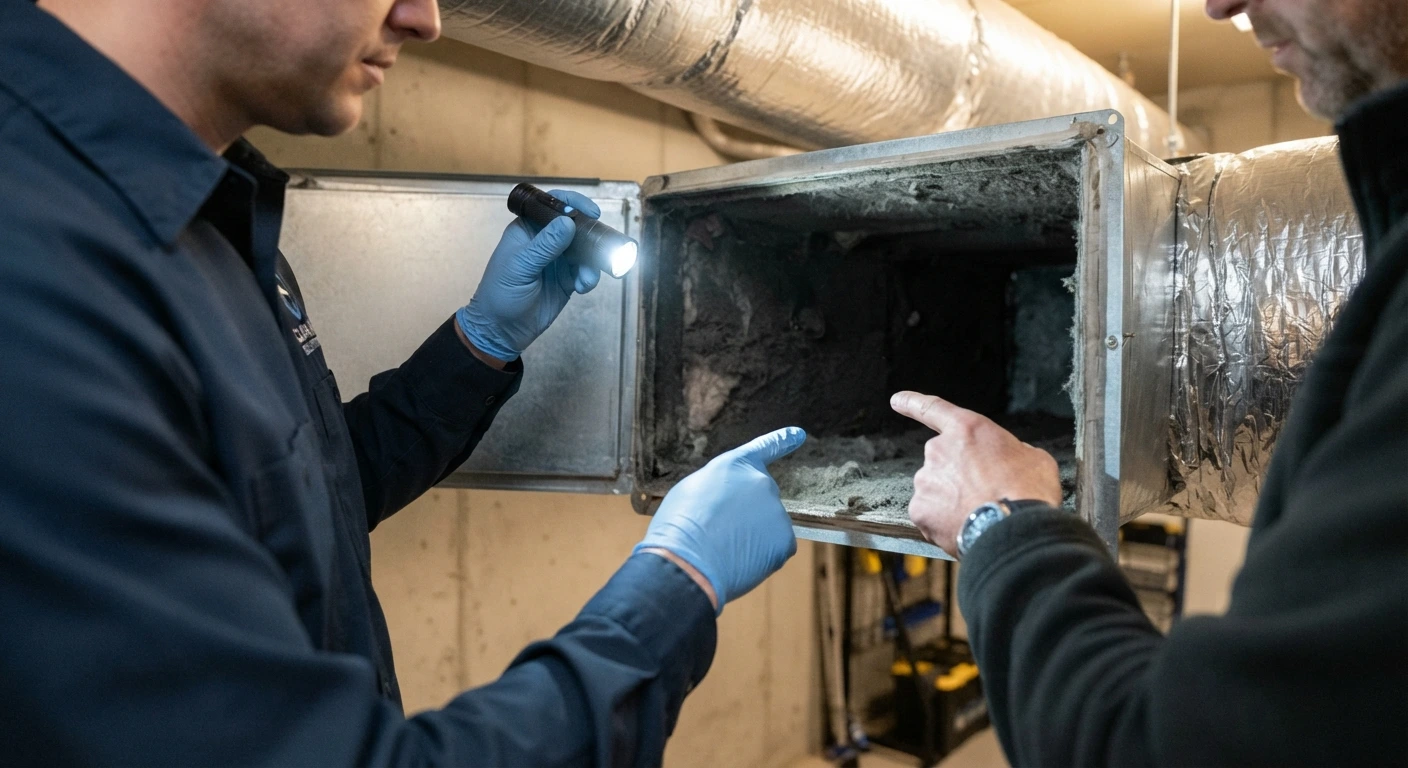
If an office HVAC system already contains construction dust, debris, pest material, or substantial deposits from years of operation, changing to MERV 13 does not remove them.
The same applies to a home.
Replacing a MERV 8 filter with a MERV 13 filter may improve future filtration, but the new filter cannot clean material located twenty feet down a supply duct.
This is where the distinction between filtration and air duct cleaning becomes important.
The EPA does not recommend duct cleaning as automatic maintenance on a set schedule. It suggests considering cleaning when ducts contain substantial visible mold growth, are infested with vermin, or are substantially clogged with excessive dust and debris, and particles are being released into occupied spaces.
A MERV 13 Filter Does Not Remove Mold From Duct Surfaces
Mold on an HVAC surface is not removed by installing a higher-rated filter.
A filter may capture some airborne spores passing through it. That does not correct existing growth or the moisture problem that allowed growth to occur.
Moisture has to be addressed first.
If water continues entering the system through condensation, drainage problems, leaks, or another source, replacing filters cannot correct that condition.
The EPA also points out that mold-contaminated porous duct materials can require a different response because surface cleaning may not be sufficient.
A MERV 13 filter is therefore a filtration tool, not a mold-remediation method.
A MERV 13 Filter Does Not Remove Pest Debris From Ductwork
Rodents, insects, and birds can contaminate HVAC systems with nesting material, droppings, fur, and other debris.
A filter cannot remove those deposits.
The source of the infestation has to be corrected, access points need attention, and contaminated HVAC sections may need cleaning after the pest problem is controlled.
Installing MERV 13 while leaving an infestation inside the ducts does not solve the underlying problem.
A MERV 13 Filter Does Not Seal Leaking Ducts
Duct leakage and filtration are separate issues.
A supply or return duct with gaps, disconnected joints, damaged sections, or poor seals will not repair itself because the building uses a high-MERV filter.
Return-side leakage can be important because the system may pull dusty air into the duct network from areas that are not meant to supply air.
If this air enters after the filter location, the HVAC air filter cannot capture those particles before they reach the system.
Inspection may therefore need to look at both filtration and duct condition rather than assuming a filter upgrade solves a recurring dust problem.
MERV 13 Does Not Remove Most Gases and VOCs
MERV ratings describe particle filtration.
They do not mean a standard MERV 13 media filter removes gaseous pollutants or volatile organic compounds.
The EPA explains that control of gases and VOCs requires source control or filtration media intended for gases, such as certain activated carbon systems. Standard particulate filtration and gas-phase air cleaning perform different jobs.
A building with chemical, smoke, solvent, cleaning-product, or material odors should therefore identify the pollutant source rather than assume a higher MERV rating will remove every odor.
Can Every HVAC System Use a MERV 13 Filter?
No. This is one of the most important limits to understand before an upgrade.
EPA guidance recommends MERV 13 or the highest rating that the HVAC system’s fan and filter slot can accommodate.
A filter creates resistance to airflow. The amount depends on the filter design, size, thickness, face area, particle loading, and operating airflow.
This does not mean MERV 13 automatically damages HVAC equipment.
It means compatibility should be checked.
A filter that is too restrictive for a particular system can reduce airflow. A poorly fitted filter can also allow bypass, defeating part of the reason for installing higher-efficiency media.
Commercial buildings need particular care because equipment configurations vary. An air handler may use filter banks with different dimensions and operating requirements than a residential furnace.
Before changing filtration levels, facility staff should check:
- Filter dimensions and rack depth
- Manufacturer requirements
- Fan capability
- Current airflow
- Filter pressure drop
- Filter sealing and bypass
- Replacement schedule
- Condition of coils and blower components
A higher number on the filter is not useful if the HVAC system cannot move the required airflow through it.
Does MERV 13 Mean You No Longer Need Air Duct Cleaning?
No. It also does not mean a property automatically needs duct cleaning.
The two services answer different questions.
A MERV 13 filter asks, “How efficiently are we capturing airborne particles passing through this filtration point?”
Air duct cleaning asks, “Is there contamination already inside the HVAC system that warrants removal?”
A building can have a MERV 13 filter and clean ducts.
It can also have a MERV 13 filter and dirty ducts because contamination existed before the upgrade, entered through bypass or leakage, or came from construction, moisture, or pests.
Likewise, ducts that have been cleaned can become contaminated again if filter bypass, moisture, pest access, or construction exposure remains unresolved.
That is why cleaning and filtration work best as separate parts of an HVAC maintenance strategy.
HVAC unit cleaning services may also be relevant when contamination involves coils, blower areas, cabinets, or other components rather than duct runs alone.
MERV 13 Filters Need Replacement to Keep Doing Their Job
Installing the right filter is only the first step.
As an HVAC air filter collects particles, the filter becomes loaded. Replacement timing depends on the filter, building use, operating hours, particle load, manufacturer guidance, and pressure drop.
A busy commercial property may load filters differently from a small home.
Construction work can shorten filter life because fine dust enters the HVAC system in a short period. Wildfire smoke, outdoor pollution, pets, and building activity can also affect loading.
Facility teams should therefore avoid relying only on a date printed on a generic maintenance calendar.
Filter condition and system requirements matter.
If the filter becomes overloaded, airflow resistance can rise. If staff remove the filter and run the system without one, contaminants have a direct path into the HVAC equipment.
The goal is consistent filtration, not simply purchasing a MERV 13 product once.
MERV 13 Filters and Air Duct Cleaning Work Best as Different Layers of Control
For commercial properties, the most useful approach is to separate prevention from correction.
A properly fitted MERV 13 filter helps control new airborne particulate matter entering through the filtration point. A sealed filter rack reduces bypass. Filter replacement keeps that protection working.
Inspection identifies what is happening deeper in the system.
If ducts are substantially contaminated, air duct cleaning can remove material that filtration cannot reach. If the problem is a leaking return duct, the leakage needs correction. If moisture is present, the moisture source needs to be fixed. If coils or blower components are dirty, those components need their own maintenance.
Homes follow the same logic on a smaller scale.
A homeowner who installs MERV 13 after a renovation may improve filtration going forward, but construction dust already deposited in the duct system remains where it settled. A homeowner with pest contamination needs pest control and an HVAC assessment, not just a new filter.
There is no single product that handles every source of HVAC contamination.
Use the MERV 13 Filter for Filtration, Not as a Substitute for Clean Ducts
A MERV 13 filter can be a useful upgrade when the HVAC system can support it. It captures more fine particles than lower-efficiency filtration and can help limit the amount of new particulate matter moving beyond the filter. What it cannot do is remove old duct deposits, clean mold from HVAC surfaces, remove pest debris, seal duct leaks, or correct contamination that bypasses the filter.
If dust keeps returning after filter changes, particles are appearing at registers, or your building has gone through construction, pest activity, or another contamination event, the duct system may need to be inspected instead of relying on another filter upgrade. Delta Clean Air provides residential and commercial air duct cleaning and HVAC cleaning services in Boston and communities across Massachusetts. Contact Delta Clean Air for air duct cleaning to have the system assessed and determine whether the issue is filtration, existing duct contamination, or another part of the HVAC system.